
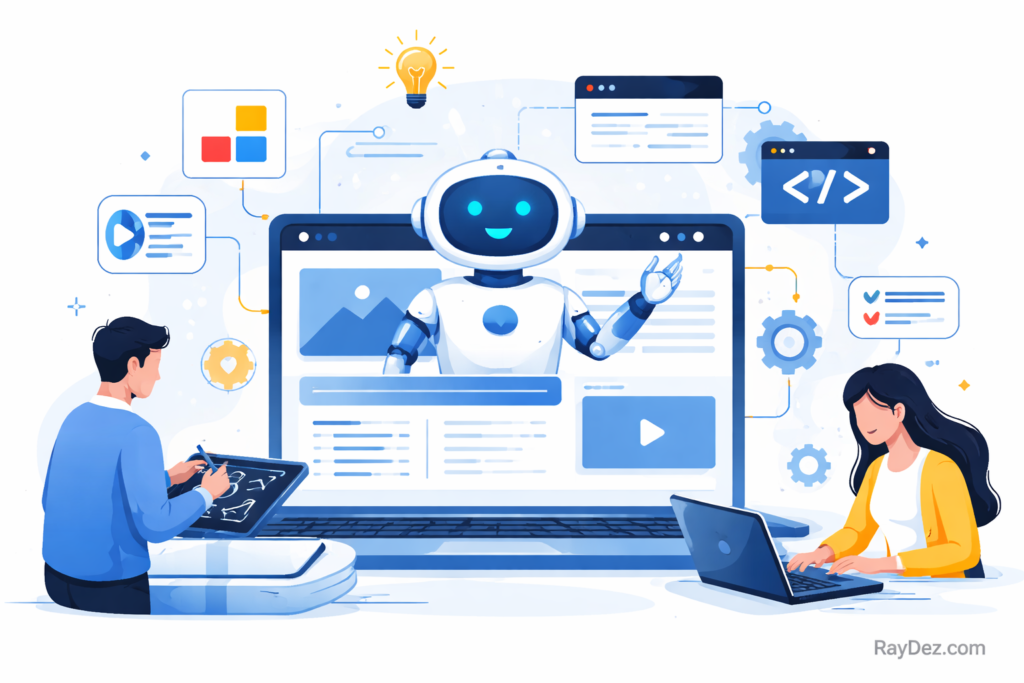
Web design and development are entering a different kind of era. Earlier waves of digital change gave us better software, faster frameworks, and more efficient workflows. AI is doing something broader: it is changing how ideas are explored, how visuals are created, how code is written, how websites are tested, and even how teams are structured. What used to require a designer, a developer, a copywriter, and several rounds of back-and-forth can now begin with a prompt and move forward at surprising speed. OpenAI, Google, Anthropic, GitHub, Adobe, Midjourney, and others now offer tools that generate images, assist with coding, or act more like agents than simple assistants.
That does not mean the old craft disappears overnight. It means the center of gravity shifts. Routine production work becomes easier, faster, and cheaper. Taste, judgment, system thinking, brand consistency, business understanding, and trust become more important. For agencies, freelancers, founders, and outsourced teams, this is both an opportunity and a warning. The people who learn to work with AI will not simply do the same work faster. They will do different work, at a higher level.
Why This Shift Feels Bigger Than Previous Tech Shifts
The reason AI feels so disruptive is that it is hitting both sides of the web business at once. On the visual side, image tools can now generate concepts, layouts, illustrations, ads, product scenes, and edits in minutes. On the engineering side, coding systems can read a repository, edit files, run commands, generate tests, and help ship features across multiple files and tools. This is no longer just autocomplete. It is the beginning of agentic work.
At the same time, the labor-market signals are no longer theoretical. The IMF says nearly 40% of global jobs are exposed to AI-driven change, while the World Economic Forum says job disruption could affect 22% of current jobs by 2030, with 170 million roles created and 92 million displaced. The same WEF research says 41% of employers plan to reduce workforces where AI automates tasks, even as many also plan to hire for AI skills and invest in reskilling.
So this is not a passing trend or a hype cycle that can be ignored. It is a restructuring of workflow, value, and skill demand. Yet it is also important not to become too dramatic. The data does not support a simplistic “all jobs vanish” story. PwC’s 2025 AI Jobs Barometer argues that AI can make workers more valuable, not less, even in highly automatable jobs. Anthropic’s own labor-market work also suggests there is still a meaningful gap between what models can theoretically do and what they are actually doing across the economy today.
AI and the Explosion of Image Creation
The visual side of web work has changed first in the most visible way. It is now much easier to generate hero concepts, moodboards, campaign visuals, icons, social images, background scenes, mockups, and product variations without starting from scratch in Photoshop or Illustrator. The big difference from early image generators is not just image quality. It is controllability. Newer systems are much better at following instructions, editing existing images, preserving context, and handling text inside images.
Here are some of the major options available right now:
- ChatGPT Images / GPT Image: OpenAI’s current image tools can both generate and edit images, and its latest GPT Image models are described as natively multimodal, with stronger instruction following and contextual awareness than older DALL·E-style systems.
- Adobe Firefly: Adobe positions Firefly as a practical creative tool for generating images, editing content, and building scene-based visuals for commercial workflows.
- Midjourney: Midjourney remains one of the strongest tools for style exploration and concept imagery, and its web editor supports Remix, inpainting, pan, and zoom workflows. Its current default version is V7.
- Google Gemini image tools: Google’s Gemini image stack now includes newer models such as Gemini 3 Pro Image and Nano Banana 2, with emphasis on text rendering, localization, and faster iteration inside Google’s ecosystem.
- Stability AI: Stability continues to matter for teams that want API access, self-hosting, or more control over deployment and customization through Stable Diffusion-based image systems.
For a web agency or outsourcing partner, this changes the creative pipeline. Instead of spending the first few days hunting for references, assembling rough mockups, or waiting on stock assets, teams can produce three to ten directions quickly, refine the best one, and then hand off only the strongest concepts for human review. That compresses the early design cycle dramatically. It also lowers the barrier for smaller businesses that could not previously afford heavy custom visual work.
But there is a catch. Easy image generation does not automatically produce brand consistency. AI can create abundance, but not necessarily restraint. A business may now create fifty visuals in a day and still end up with weak design if none of them fit the brand, communicate the offer clearly, or support conversion. That is one of the first places where human taste still matters deeply. The problem is no longer lack of output. It is choosing the right output.
AI in Development: From Copilot to Coding Agents
What has happened to development may turn out to be even more consequential. AI coding tools are no longer limited to writing a few lines of boilerplate. Many now operate more like software agents. They can inspect a project, search files, propose changes across the codebase, generate tests, review diffs, and help move work through Git-based workflows.
Some of the most visible options right now include:
- OpenAI GPT-5.4 and Codex: OpenAI’s current model lineup explicitly positions GPT-5.4 for complex reasoning and coding, while Codex is presented as a coding agent that helps teams build and ship with AI.
- Anthropic Claude Code: Claude Code is designed to read a codebase, edit files, run commands, and automate development work across tools and environments such as terminal, IDE, desktop, and browser. Anthropic’s model docs also position Claude Opus 4.6 as its strongest broadly available model for coding and reasoning.
- GitHub Copilot: GitHub now frames Copilot around agentic workflows, from edits to pull requests, rather than only inline suggestions.
- Gemini Code Assist and Gemini CLI: Google’s tooling spans IDE assistance, code generation, debugging, documentation, source citations, and terminal-based agent workflows through Gemini CLI. Google also explicitly says users should validate model output because the system can still generate plausible but incorrect information.
In practical terms, this means AI can now help with a large share of ordinary web development work: scaffolding landing pages, generating component variants, writing tests, migrating old code, building dashboards, explaining unfamiliar repositories, drafting SQL queries, documenting APIs, and even fixing bugs from logs. For outsourced teams, this can improve delivery speed enormously, especially in repetitive or process-driven projects. A smaller team can now produce far more than the same team could a year or two ago.
Still, the quality warning matters. Google explicitly recommends validating Gemini Code Assist output. That applies more broadly across the category. AI can write code that looks convincing but breaks edge cases, introduces subtle security issues, or solves the wrong problem beautifully. So the job of the developer shifts upward: less typing every line by hand, more reviewing architecture, debugging intent, checking security, and deciding what should or should not be automated in the first place.
What AI Will Automate First
The first wave of automation is not mysterious. It tends to hit work that is repetitive, pattern-based, low-context, and easy to verify. In design, that includes ad variants, concept exploration, social creatives, icon treatments, product backgrounds, image expansion, and simple UI mockups. In development, it includes boilerplate, CRUD scaffolding, test generation, refactoring, documentation, small bug fixes, and routine front-end assembly.
That is one reason the WEF specifically flags some roles, including graphic designers, among those likely to decline more quickly as generative AI reshapes work. It is also why clerical, administrative, and routine support roles continue to sit near the center of disruption. The more the task looks like transformation of existing patterns, the more AI can pressure it.
But exposure is not the same as full replacement. Anthropic’s labor-market research argues that actual usage still falls short of theoretical capability, and that many barriers remain, including human verification steps, legal issues, software constraints, and workflow friction. In other words, a task may be technically automatable and still remain partly human for years.
Layoffs, Job Impact, and the Hard Reality
There is no honest way to write about AI and work without discussing displacement. In the United States, Challenger, Gray & Christmas reported that AI led all reasons for announced job cuts in March 2026, with 15,341 cuts that month alone, about 25% of total announced cuts. The same report said technology companies announced 52,050 job cuts in the first quarter of 2026, up 40% from the same period a year earlier. Challenger also said companies are shifting budgets toward AI investments at the expense of jobs, especially where coding functions can be replaced or reduced.
That said, long-term impact should not be measured only in layoffs. The broader global estimates point to reallocation, not just elimination. The WEF’s current forecast suggests a net increase in jobs by 2030, even though 92 million roles are expected to be displaced, because 170 million new roles are also projected to emerge. The IMF’s framing is similar: many jobs are exposed to AI, but the effect is mixed, not uniformly destructive.
So if someone asks, “How many jobs will AI impact roughly?” the safest answer is this: a very large share. The IMF says nearly 40% of global jobs are exposed to AI-driven change. The WEF says job disruption could affect 22% of current jobs by 2030. Neither number means those jobs disappear completely; it means job content, skill requirements, and staffing patterns are already shifting.
How Professionals Need to Evolve
The wrong response is denial. The second-worst response is panic. The right response is repositioning.
Designers and developers should stop thinking of themselves only as makers of final output and start thinking of themselves as directors of systems, taste, and outcomes. If AI can produce ten homepage variations, the higher-value skill is not merely drawing one more variation. It is understanding the business, selecting the right variation, knowing what to reject, and shaping the final experience so it feels coherent, persuasive, fast, and trustworthy.
The same goes for developers. In an AI-assisted world, the best engineers will be the ones who can define architecture, set standards, review machine-generated code, control complexity, secure systems, and decide when AI output is good enough to use and when it is dangerous to trust. The typing part matters less. The judgment part matters more.
If someone wants a practical roadmap, the highest-value areas to build now are AI literacy, prompt design, quality assurance, accessibility, security, systems thinking, analytical thinking, and communication. The WEF’s skill forecasts are instructive here: AI and big data, cybersecurity, and technological literacy are rising fast, but so are creative thinking, resilience, flexibility, curiosity, and lifelong learning. That combination is the real clue. The future belongs neither to pure technical skill alone nor to vague creativity alone, but to people who can combine both.
What Human Touch Will Mean in an AI-Saturated Future
This may be the most important section in the article, because it is where the conversation usually becomes shallow. Many people speak about “human touch” as if it simply means handcrafted work. In the future, human touch will mean something more specific and more valuable.
It will mean taste: knowing what feels right for a specific audience and brand, not just what looks impressive in isolation. It will mean empathy: understanding what a client is afraid of, what a customer hesitates over, and what kind of interface actually builds trust. It will mean judgment: deciding when something is legally risky, strategically weak, emotionally tone-deaf, or simply too generic. And it will mean accountability: when a campaign fails, a checkout breaks, or a site miscommunicates the offer, a human still has to own the decision.
In fact, AI may increase the value of human touch because the market will be flooded with passable output. When everyone can generate decent-looking visuals and decent-looking code, businesses will pay more attention to what is distinctive, trustworthy, and aligned. Average work becomes abundant. Strong judgment becomes scarce. That scarcity is where human value survives and grows. This is also where better outsourcing firms can differentiate themselves: not by saying “we use AI,” because everyone will, but by showing that they can combine AI speed with human supervision, strategy, and refinement.
A Reasonable 10-Year View
No one can forecast 2036 with confidence, and anyone who speaks with total certainty here is probably pretending. But a reasonable scenario is becoming clearer.
Over the next ten years, commodity production work in web design and development is likely to become dramatically cheaper and faster. But personalized items that embody human emotions would become precious. These free fonts & graphics with floral designs are an example of professional but personalized design items.
A small team, using strong AI systems well, may be able to do the output of a much larger team from the pre-AI era. Many first drafts of sites, graphics, layouts, tests, marketing copy, and even app features will be produced primarily by AI and then reviewed by humans. Outsourcing will not disappear, but low-value outsourcing will be squeezed hard. What will remain valuable is high-trust outsourcing: teams that can align with business goals, manage AI well, verify quality, and take ownership of the final result. That is an inference from the current direction of AI tooling, labor-market forecasts, and employer skill priorities, not a precise prediction.
The labor market will likely become more polarized. Roles built around repetitive execution may shrink. Roles built around oversight, orchestration, product judgment, compliance, domain knowledge, and client trust may expand. The WEF already points to rising demand for a blend of technical skills and human-centered skills, while PwC’s current view is that AI often raises productivity and value rather than simply deleting work. Taken together, that suggests the future is less about humans versus AI and more about humans who can direct AI versus humans who cannot.
Conclusion
AI is not just another software feature for web design and development. It is becoming part of the production system itself. It can generate images, edit assets, scaffold interfaces, write code, test code, review repositories, and accelerate delivery across the stack. That will absolutely affect jobs. It already is. But the deeper story is not simply replacement. It is redesign.
The safest path forward is not to defend old workflows out of habit. It is to become better at the parts AI still cannot own well: direction, judgment, empathy, trust, systems thinking, brand understanding, and accountability. The winners in the next decade will not be the people who insist on doing everything manually, nor the ones who blindly hand everything to machines. They will be the ones who know where automation helps, where human touch matters, and how to combine the two into stronger outcomes.
